Market research
Mini apps are how China uses the internet
China's mini-app economy is not one feature of one messenger. It is how much of the country gets online, and it runs across four large super-app platforms, Weixin, Alipay, Baidu and Douyin, plus a real tail of smaller runtimes and a separate OS-level standard. Most of it is hard to see from outside, because the West watches the international apps, WeChat and TikTok, while the traffic sits on the mainland originals, Weixin and Douyin. This paper maps that economy and labels every number for what it measures.
Ask most people in tech what a mini app is and they will point at WeChat, as if it were one clever feature of one Chinese messenger. In China it is much more than that. The app inside an app is a normal way to get online, built by a lot of people making a lot of apps across several super-apps rather than one. For many everyday services it has replaced both the mobile web and the trip through a native app store. This paper maps that economy and labels the numbers carefully, because most of them describe apps the West has never opened. The West is now arriving at a similar place from the other direction, bottom-up through vibe-coding, which is why China reads as a preview rather than a curiosity.
The apps China uses have different names
The West watches WeChat and TikTok, while China uses Weixin and Douyin. These are not nicknames for the same products but separate apps.
Tencent runs both WeChat and Weixin, and says so itself: "While interoperable, WeChat and Weixin are separate and distinct services" (WeChat's official newsroom). A foreign phone number registers WeChat, the international version; a Chinese number registers Weixin, the mainland one. Their data is even held in separate jurisdictions, a consequence of China's data rules. Tencent reports a single combined figure, 1.43B monthly accounts in Q1 2026, and has never split it. The majority are Weixin users; outside estimates put international WeChat at only 100 to 200 million.
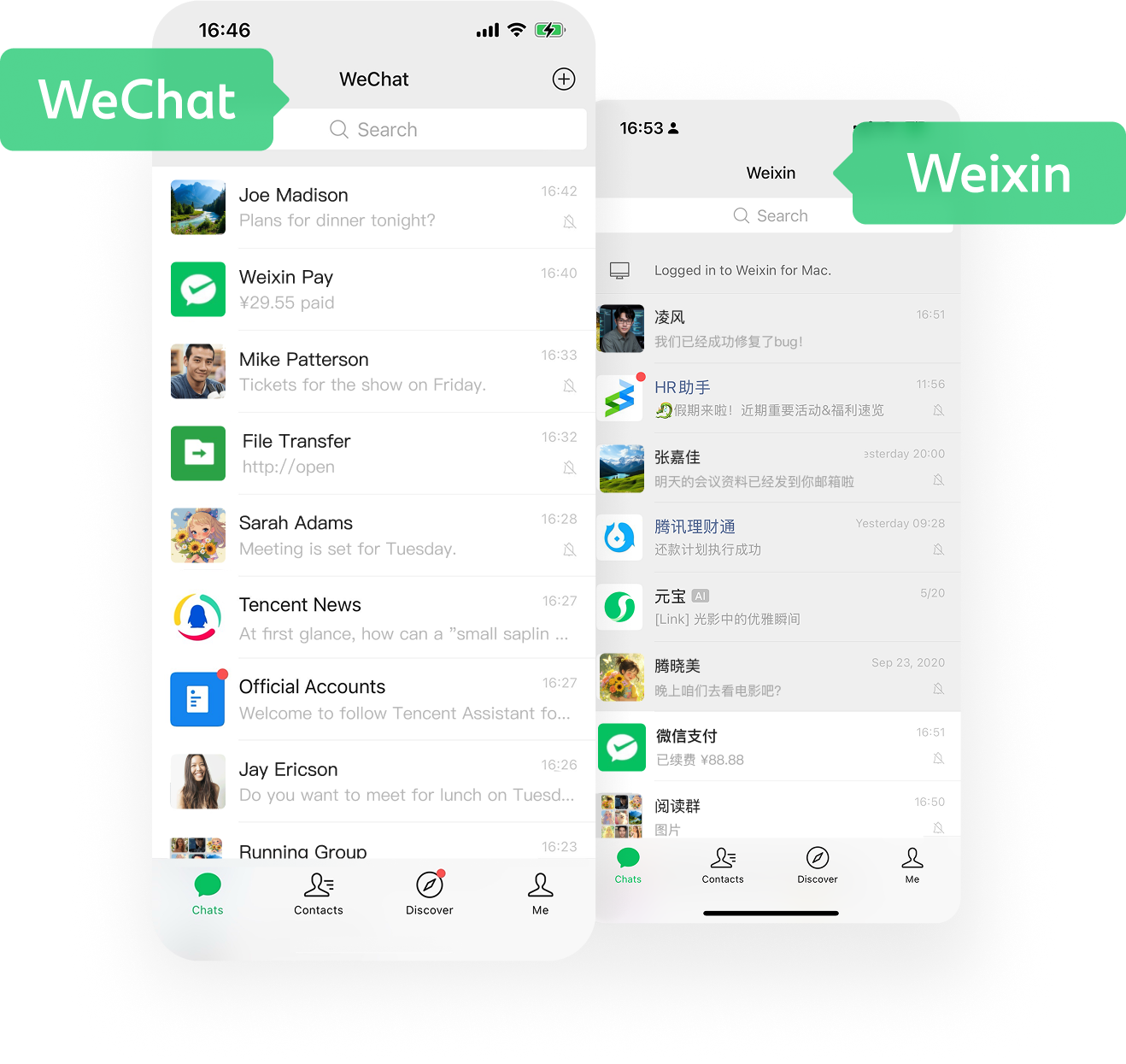
ByteDance runs TikTok and Douyin the same way: one interface, but separate platforms, separate infrastructure, and no shared content. TikTok is the app outside China; Douyin is the one about 900 million people use inside it.
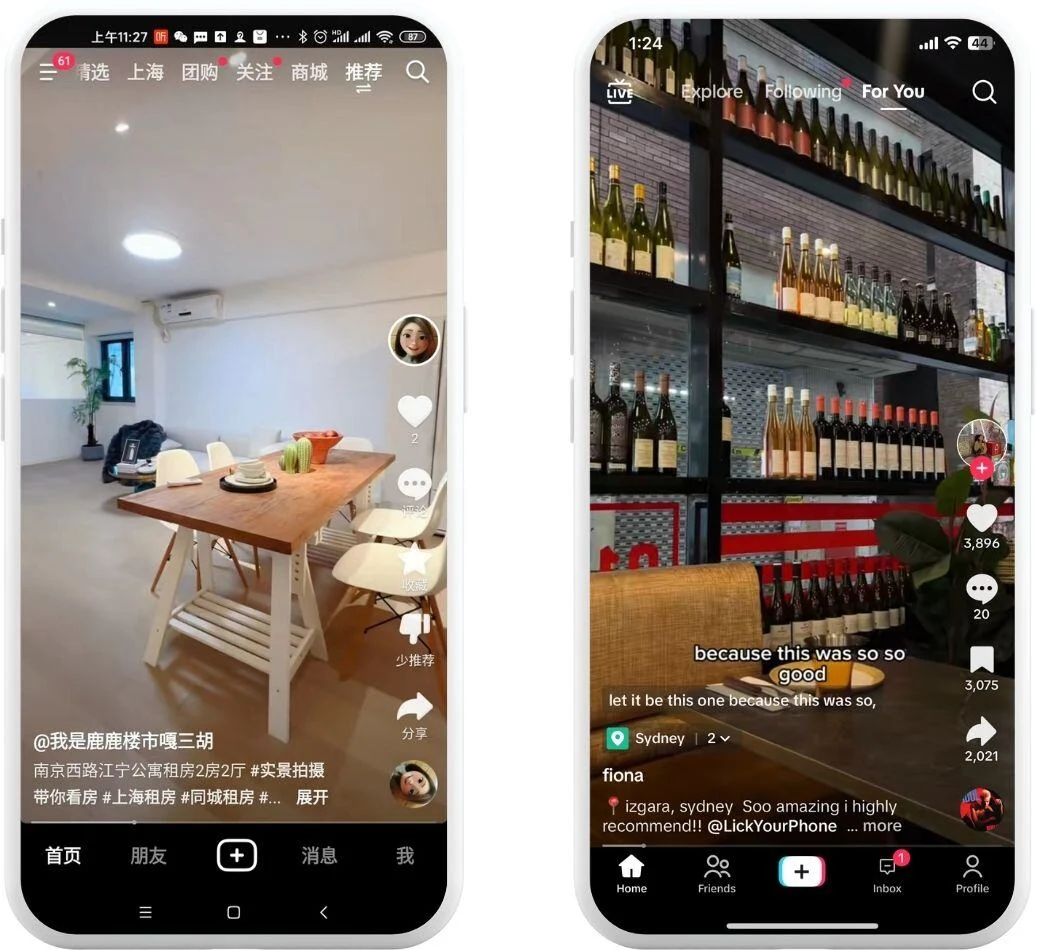
It matters because nearly every figure the West quotes about "WeChat" or "TikTok" is really a figure about Weixin or Douyin, the apps it has never opened. The users, and the entire mini-app economy built on them, sit on the versions that are hard to see from outside.
Four platforms, not one store
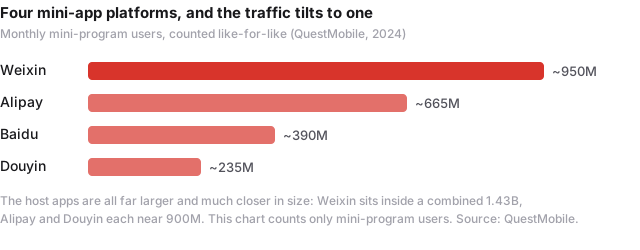
There is no single Chinese mini-app store, and no single host. Ranked by their own mini-program users, four platforms dominate: Weixin, Alipay, Baidu and Douyin (QuestMobile, 2024). Each runs its own mini-app runtime with its own markup language, so a developer who wants to be everywhere writes the same app more than once.
One caution about the numbers, since this is where most outside coverage goes wrong. The four host apps are all large and close in size, with Alipay and Douyin each near 900 million monthly users and Weixin inside Tencent's combined 1.43 billion. Host size is not the same as mini-app size, though. Counted like-for-like, by the people who use the mini-programs inside each app, the traffic is not spread evenly. It leans toward Weixin, though all four carry a lot of it.
The four also specialise. Weixin is the broad generalist, cutting across every category and carrying most of the social-commerce money, which it won on the sharing graph. Alipay is the money-and-identity platform, strong in finance, government services and anything that needs a verified real name. Douyin is feed-driven and impulse-led, where the For You video feed is what sends people into a mini-game or a store. Baidu is search-led, surfacing mini-programs from what people are already looking up.
Below the four sits a real tail of genuine third-party runtimes, including Kuaishou, Tencent's own QQ, and JD, plus vertical players such as Xiaohongshu and Bilibili. Separate again is an operating-system layer that does not belong in the super-app count at all: Quick App, an install-free runtime the Android handset makers ship across their phones, and Huawei's HarmonyOS atomic services. The honest shape is four dominant platforms, a genuine tail, and a separate OS-level standard, rather than a single clean number.
The count of individual mini-programs tells the same story of scale that is hard to pin down. The total ran past 4.3 million as long ago as 2021, already more than Apple's App Store and Google Play combined, and the count has kept climbing since, though there is no clean current figure, because the main independent tracker has gone dark.
Because no one wants to build the same app four times, a layer grew on top. Cross-platform frameworks such as Taro and uni-app let a developer write once and compile out to every super-app. That these frameworks are mature and widely used is itself evidence that publishing across super-apps is a real, demanded category.
What people do inside
Mini-programs are not one kind of thing. They cover the everyday map of services, and each super-app leads a different part of it: Weixin across daily life and commerce, Alipay wherever money and a verified identity are needed, Douyin in feed-led content, Baidu off search.







Three of those categories reach almost everyone who uses mini-programs at all. Local life and O2O, mobile shopping, and finance each touch on the order of 880 million Weixin mini-program users (QuestMobile, 2024). These are the daily-utility scenarios: order from a table QR code, pay a bill, move money into a fund with the wallet's identity already verified. Healthcare and short-video are the fastest risers, up 34.3 and 40.6 percent year on year.
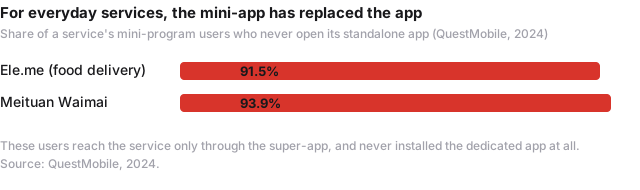
How completely this has taken over shows up at the level of a single service. For food delivery, the large majority of a service's mini-program users never install its standalone app at all: 91.5 percent for Ele.me and 93.9 percent for Meituan Waimai. That is the most recent clean read (QuestMobile, 2024), since the main independent tracker has since gone dark.
By reach the picture is broad and flat, but time is spent unevenly. Mini-games alone take 36.4 percent of all the time people spend inside mini-programs, the single largest slice, even though far fewer people play them than shop. The fastest-growing content is the short vertical drama, sold by the episode. By February 2026 short drama reached about 718 million viewers across apps and mini-programs (QuestMobile), and the market had already passed the mainland box office in 2024, at about 50.5 billion RMB against 42.5 billion.
The money underneath is real, and Tencent discloses some of it directly. Weixin reported that mini-program transactions passed 2 trillion RMB, roughly 280 billion US dollars, in the third quarter of 2024 alone. That is transaction value rather than revenue, but it is the platform owner's own figure, and it is the cleanest single measure of the economy sitting on top of the app.
How it works
When an app lives inside an app you already use, trying it costs nothing. Someone shares a link in a chat, or you scan a QR code on a table or a package, and the thing opens. You skip the install, the account setup and the trip through a store. Distribution comes from sharing and from search, not from a ranking, and there is no browsable store to rank in. Weixin removed user reviews years ago.
This was deliberate. Zhang Xiaolong, who built Weixin, described the ideal as 用完即走, use it and leave. He withheld a home-screen slot, a feed and push notifications from mini-programs, so that need would pull people in rather than a store pushing them. That restraint is part of why the format became trusted enough to carry payments and government services.
Underneath, the thing that lets hundreds of thousands of outside developers ship code inside the host without putting its users at risk is a strict sandbox. A mini-program's logic runs in a separate thread from what it draws on screen, with no direct access to the page or the browser, so the host keeps a hard boundary around its users. A size cap of a couple of megabytes for the main package keeps these things light.
How it got here, briefly
The format did not arrive fully formed. Weixin launched mini programs in January 2017 and they underwhelmed for most of that year, in large part because of the restraint above. The turn came at the end of 2017, when Weixin shipped a small tap-to-hop game called Jump Jump, built more or less as a demo, and about 170 million people played it within two weeks. That proved the distribution the quiet launch had hidden, with day-7 retention holding around 52 percent, well above the mobile-game norm, and developers came back.
From there the format widened. Pinduoduo grew into a public company largely on Weixin's group-chat sharing. In 2020 the COVID health codes, built as mini-programs, put the format in the pocket of close to 900 million people as the thing they opened to leave the house. At that point it stopped being a commerce novelty and became civic infrastructure.
Where the economy sits
Fixing the names changes what the numbers mean. Put the mainland app next to its international twin and the audience and the economy point in opposite directions: TikTok has the bigger audience, but the mini-app economy sits on Douyin.
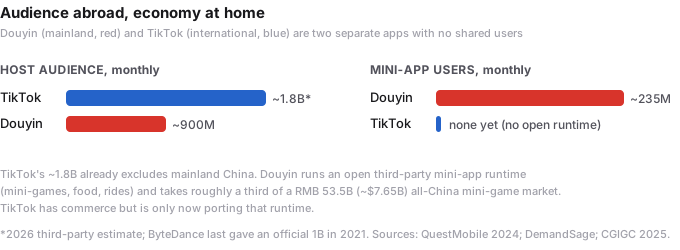
Douyin and TikTok share an interface, but not the economy behind it. Douyin runs a mature, open mini-app layer inside the app, where independent developers ship mini-games, food ordering, ride-hailing and other services. It takes roughly a third of the all-China mini-game market, which reached 53.5 billion RMB, about 7.65 billion US dollars, in 2025, up about 34 percent year on year. TikTok has Shop and livestream commerce but not that open runtime; TikTok Minis is early and limited, and mostly ports the model Douyin has run for years.
The same holds for Weixin against international WeChat. The mini-program users and the living economy on top of them are on mainland Weixin. Every headline figure the West quotes about WeChat is really a figure about the app it has never opened. Part of why it stays hard to see is that the mainland platform is closed to outsiders. Building a real, payment-capable mini-program requires a Chinese company and Chinese filings, and the network itself is walled. Foreign developers do not experience this economy from the inside, so they tend to under-count it.
Why China is a preview
China is specific in ways that do not travel. A firewall, a handful of dominant super-apps, and banking and government woven directly into everyday apps are features of China, and the state and bank entanglement in particular does not carry over to open markets.
What does carry over is where this ends up, and China and the West are getting there from opposite directions. China went top-down. Mini programs were a decision made inside one company, they nearly failed, and an ecosystem of independent makers grew only after the platform had proved the distribution. The West is going bottom-up. Building an app has become a mass activity through vibe-coding, which produced the supply first: a very large number of apps and almost no way for most of them to reach a single user. The classic app store was never designed for that volume, so distribution moves to where people already are, inside the apps they already open.
One outside data point is worth noting. In November 2025 Apple created a named Mini Apps Partner Program, with a reduced 15 percent commission for self-contained mini-apps that run inside host apps, and it named Weixin, Douyin and Kuaishou as the marquee cases. When Apple writes a specific rule for the mini-app-inside-a-super-app pattern, that is a sign the shape is durable rather than a local oddity.
Where to read next
- Multi-ecosystem: how @appss carries one build across many messenger surfaces.
- Why now: the macro window this sits inside.
- Email mark@engagelabs.org for the full source materials and the per-number verification log behind this paper.