The mass adoption of personal software
are:


 85K+ on-the-fly integrated MCPs, connectors and data sources





 25+ platforms



 Telegram team
 Mark Okhman
Apps are becoming user generated content. AI now writes most of the code, so one person can ship a working app in a weekend, the way the phone camera once turned everyone into a video producer. The hard part has moved from building the app to everything after it.
We build that missing layer: tools to create, distribute, manage and monetize apps at the speed people produce TikToks and Reels. Creators build native and mini apps in each platform's own stack, deploy on our managed cloud, and reach users through @appss, a store driven by a social graph rather than search.
We are an ex-Telegram team, and we hit these problems building apps ourselves. Notspy, a portfolio app on our own stack, runs profitably with 115K real users. The tooling started as what we needed to operate; we packaged it so any creator can run the same playbook.
Apps are turning into content. AI writes most of the code now, so building one is no longer the hard part: a single person can ship a real app in a weekend. What's still hard is everything after the build - getting it in front of users, keeping them, handling identity, payments, support, and the numbers. That work used to need a funded studio. It still does, unless someone packages it.
@appssPro is that package: one place to research, build, launch, grow, and monetize an app - built native to each platform's own stack: a Telegram app, a WhatsApp Flow, a TikTok mini, a YouTube playable, each in the real SDK and UI of the ecosystem it lives in. Creators build with an AI builder that knows those formats, deploy onto a managed cloud, and push their apps into @appss, a store that runs on a social graph instead of a search bar, so reach comes from people sharing and voting rather than ad budgets. We monetize the toolkit like a SaaS, and the audience those apps bring into the store on top of it - so subscriptions are the floor of the model, not the ceiling.
And it's already working, proven on our own apps first: Notspy, a portfolio app we built on the stack, runs profitably with 115K real users - alongside thousands of creators now building on it and thousands of apps live in the store. The proof isn't raw ecosystem reach; it's real users moving through apps we shipped ourselves. The people behind it are operators who hit these problems the hard way and decided to fix them for everyone else.
It's hard for  Tim
Tim
Tim is 26. He plans trips, runs group chats, makes things for friends. Creative, but non-tech.
It's still hard to create an app people will pay for.
A person with an idea gets working code from AI in an evening and then meets the rest of a product, the data, identity, payments, hosting, support and updates, which still takes a team to build and keep alive.





It's hard to get users.
The app is done and the hard part begins: you chase people one by one, talk them into clicking a link, signing up and installing, and most of them give up before they ever try it.



Structure follows what investors ask for: the pain of a concrete person and how they cope today (Sequoia), which of Kevin Hale's attributes make it worth solving (popular, growing, expensive for the first; mandatory, frequent, expensive for the second), and proof instead of opinion. On the slide the proof is real X posts from builders, shown as cards; the attributes are spoken.
Problem 1, spoken: popular and growing (anyone can start now, and most do; 291 build requests from 248 people on appss.pro in ten days, 17-27 Sep 2026), expensive (the remainder still costs a team). Posts: @HashamBuilds 25 Sep 2026 "every tiny feature has a database, a login flow, a bug, three edge cases and a documentation page"; @basedlayer 25 Aug 2026 "building good software is incredibly hard… maintenance, databases, server infrastructure, security"; @akarshjha03 3 Sep 2026 "Building it wasn't the hard part. Power, storage, backups, updates, database history…"; @leojrr 17 Mar 2025, 6K likes, "maxed out usage on api keys, people bypassing the subscription… I'm not technical".
Problem 2, spoken: mandatory and frequent (every app, every launch), expensive (attention is bought and stops with the spend). Posts: @caelum0x42 15 Sep 2026 "The products are done. Distribution is not. Zero users."; @WillLovesNoCode 25 Sep 2026 "Month nine… fifth vibecoded SaaS. Still stuck at zero users. Every launch drives a spike in traffic, then dies off fast"; @XTeamPal 27 Sep 2026 "Day 10: (zero users). Launched on product hunt, hacker news, indie hackers…"; @shivamkumarlogs 22 Sep 2026 "build → ship → 0 users → build a completely different app to avoid doing sales → repeat"; @Jadu100x 22 Sep 2026 "Harder than building an app: get noticed. Paid ads, SEO, socials, events." Source data: public/deck/assets/x-posts/posts.json (fetched 28 Sep 2026).
It's still hard to create an app people will pay for.Give creators capable building blocks
Let’s make it easier for creators to focus on what they’re best at: combining useful actions, interfaces and target audience.
This slide answers problem 1: making a product people pay for is hard. A product is a chain of five parts: compute, data and operations, actions (what the app does for you: book, pay, map, translate, scrape), the interface, the people. Today one company has to own every part before anyone pays; everyone else picks between being a developer or making a toy.
With @appss the creator does only the last two: the interface and their people. Everything before it already exists (85K+ MCPs, connectors, data sources) and plugs in as actions. Every paid use is settled along the chain, so nobody has to build the whole chain to get paid for their part. The logic a creator writes becomes an action too, and the next person builds on it.
Spoken line: YouTube made the unit a video, Uber a ride, Airbnb a room. Software's unit was still the company. Naming note (Mark, 2026-09-28): the third box is "small jobs to be done"; not "skills". Chosen: actions (Mark, 2026-09-28). Rejected: skills, capabilities.
It's hard to get users.Build where the entrance barrier is minimal
Below is the commitment ladder: what an app asks of a person before it does anything for them. Each step up loses most of the people who reached it.
in browser
an account
an app
payment card
a friend
identity
2026-09-30 (Mark): six steps, two lines each, no "Step N" labels. Heights 104/140/176/212/248 and Verify identity 340 (first step doubled, last one clearly taller).
Answers problem 2: it's hard to get users. The ladder is what an app asks of a person before it does anything for them. Step 0: nothing, it opens in the chat they are already in, already signed in. Step 1: open a link. Step 2: create an account. Step 3: install. Step 4: verify identity. Every step loses most of the people who reached it.
Content has lived at step 0 since 2010: a video, a post, a clip. Software almost never has. Forms, link-in-bio and web builders live at step 1. SaaS and marketplaces at step 2. Native apps and extensions at step 3. Fintech at step 4. The logos on the slide are examples of who lives on each step today, not competitors.
Spoken, not written: with @appss the same app exists at every step and opens at the bottom (iMessage, WhatsApp, Telegram, ChatGPT, Reddit, Playables), climbs to web, then to iOS, Android, Mac, widgets and push only after use; payouts sit at step 4 through @appss Pro.
Major platforms are becoming the “app stores”
iMessage apps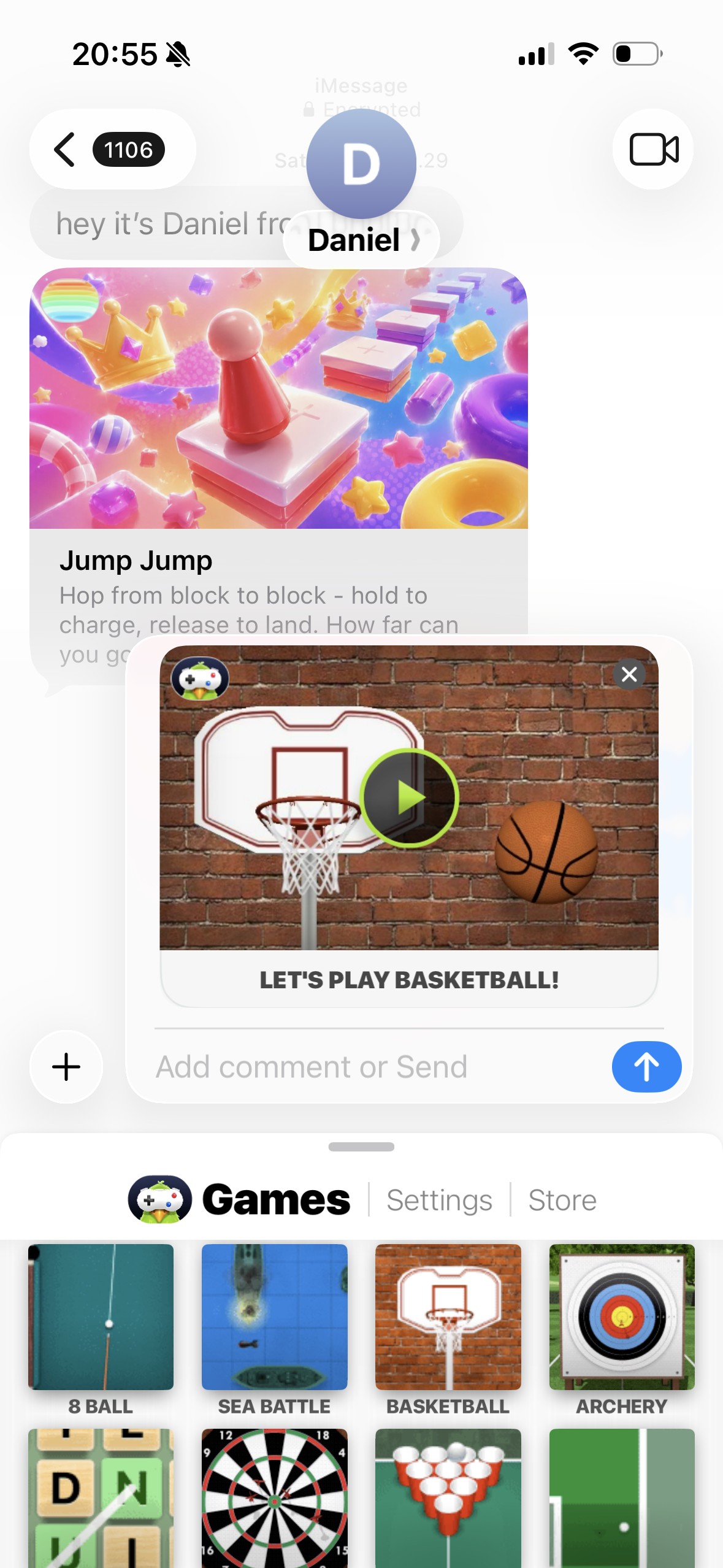 WhatsApp Flows
 TikTok Minis
 YouTube Playables
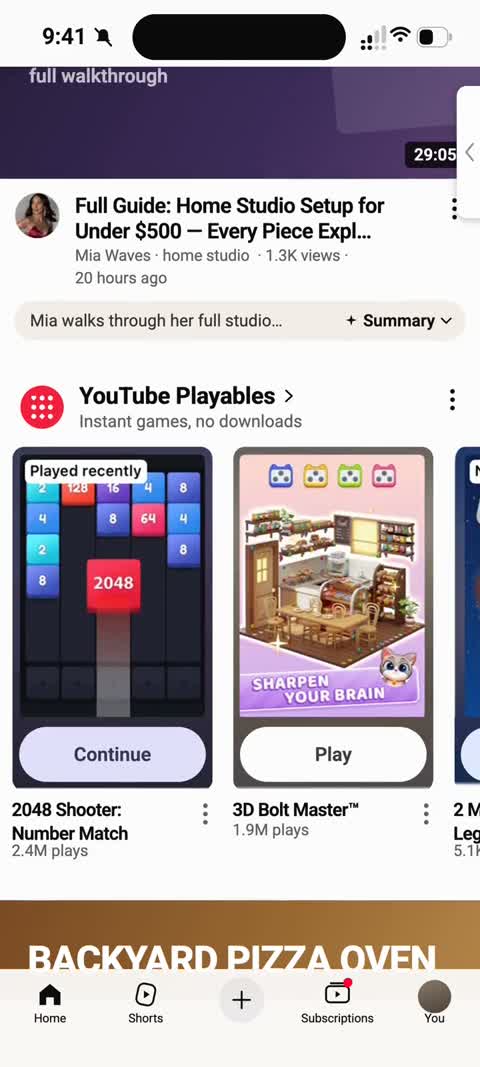 Reddit Interactive Posts
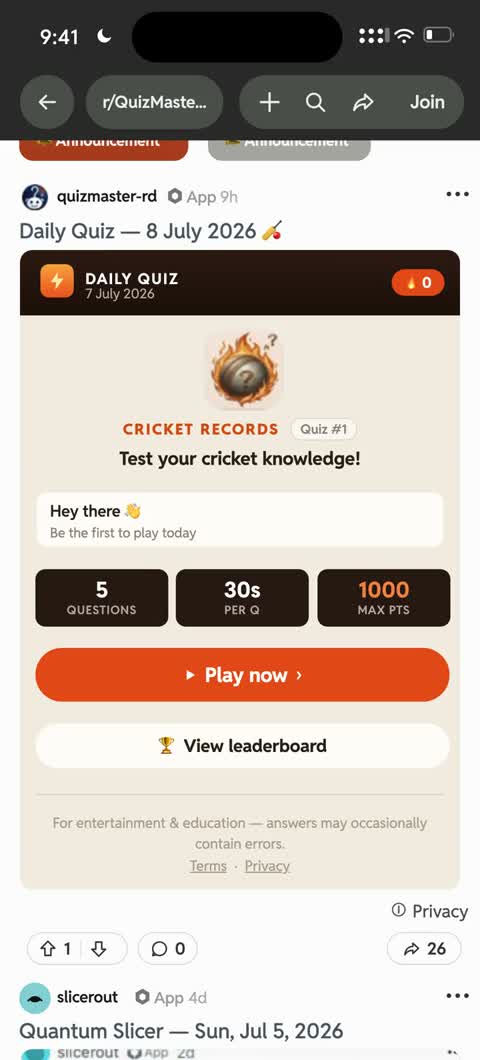 YouTube PlayablesWhatsApp FlowsInstagram DM bots
 Facebook Instant GamesTikTok Minis
 WeChat Mini Programs
 Messenger DM botsTelegram Mini AppsiMessage appsX chat agents
 Alipay Mini AppsChatGPT appsReddit Devvit apps
 Discord Activities
 World Mini Apps
 Base Mini Apps
 Farcaster Mini Apps
 LINE Mini Apps
 KakaoTalk Mini Apps
 Zalo Mini Apps
 Roblox experiences
 Slack apps
 Shopify apps
 Microsoft Teams apps
 Zoom Apps
 Twitch ExtensionsClaude apps
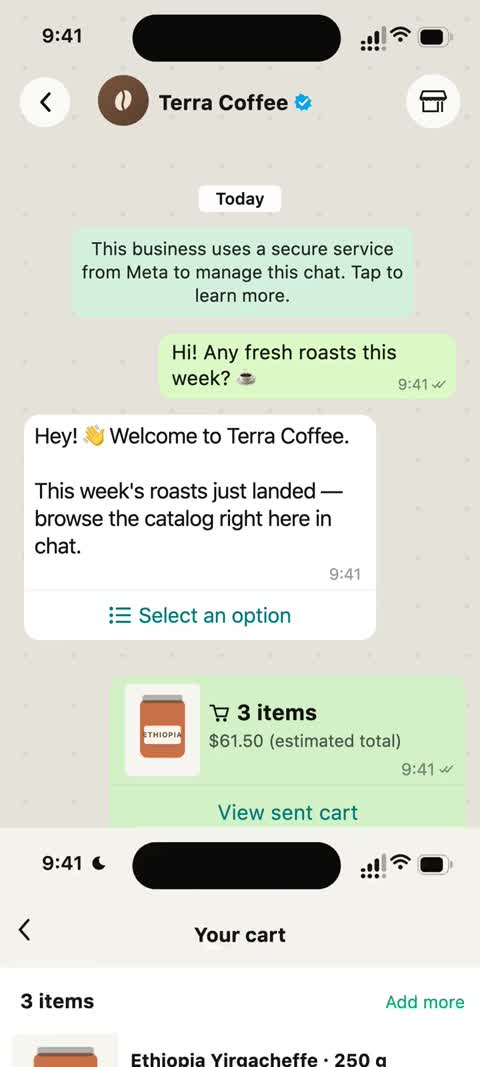
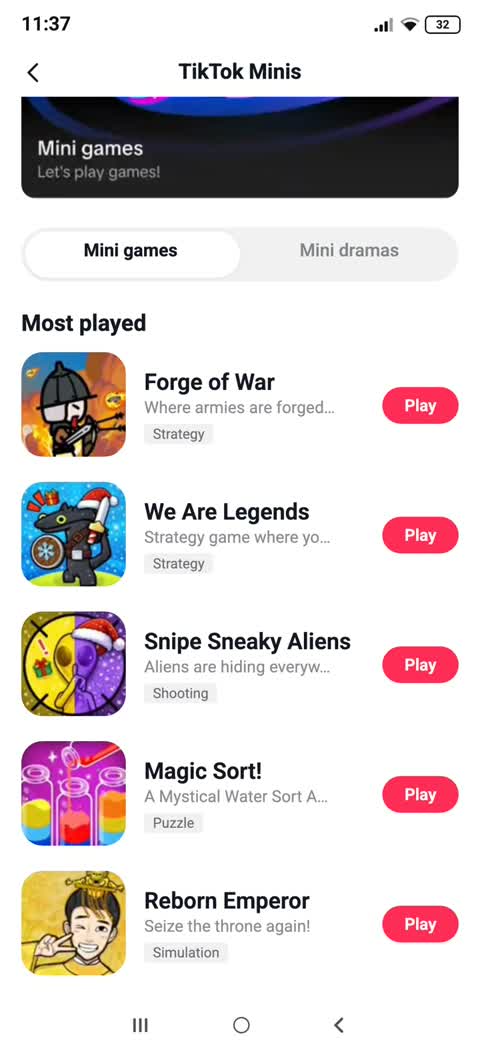
Rebuilt 2026-09-30 (Mark): title at the common size, lead about the perks of living inside a platform (signed in, push channel, one-tap sharing, no install), perk chips, five phones (iMessage, WhatsApp, TikTok, YouTube, Reddit) and the "where mini apps already live" list. The iMessage phone is a real screenshot (GamePigeon in iMessage, 2026-09-30); the other four are frames from our own promo videos.
Nine of the world's ten largest apps now host an app surface: Instant Games on Facebook, Flows in WhatsApp, Playables on YouTube, Minis on TikTok, Mini Programs in WeChat, Mini Apps in Telegram, Devvit apps on Reddit. Only X has none. Distribution is moving inside the apps people already open.
We checked the ceiling ourselves, on real devices in China this August: ten platforms, hands on. The top four apps there, WeChat, Alipay, Taobao and Douyin, are all mini-app platforms; WeChat's mini-programs alone reach 962M monthly users. Where a claimed host failed our check, like Amap or Meituan, we cut it.
The second table has a pattern: almost every significant 2026 update is about AI agents driving mini-apps. WeChat opened its mini-programs to agents in June. Alipay converted 10,000+ services into agent skills by August. Meta shipped Business Agent, UnionPay an agentic payments protocol. Mini-apps are becoming the tools agents call.
The world's top apps no longer compete on features, they compete on how much of the user's day they absorb. The end state of that competition is the super-app: every adjacent need (shopping, payments, games, productivity) gets a mini-app surface inside.
WeChat showed the pattern (2017). 4.3 million mini-programs, more apps than Apple App Store and Google Play combined. Average user runs 9.8 of them per day. 945M MAU live inside the surface, not the OS.
Telegram followed (2023), TikTok joined (2025), Apple acknowledged in Nov 2025. Every billion-user messenger or super-app on Earth has either opened a mini-app surface, or is in the process of opening one.
What «app surface» means per platform
- Full mini-app stores: WeChat Mini Programs, Telegram Mini Apps, TikTok Minis, third-party app catalogs with discovery, payments, runtime.
- In-conversation apps: WhatsApp Flows (multi-screen UI inside chat), Instagram + Messenger DM chatbots (Send/Chat APIs).
- Embedded games / interactive surfaces: Facebook + Messenger Instant Games (HTML5), YouTube Playables (browser games inside YT), Reddit Devvit + interactive posts.
- Not yet: X, payments licensed (X Money / Visa), no third-party app surface shipped despite the «everything app» pitch.
By region
- East Asia: WeChat (1.41B), Alipay (720M+), LINE (97M JP), KakaoTalk (50M KR), Zalo (79.6M VN), most mature, most penetrative
- Global / cross-border: Telegram (1B+), TikTok Minis (10 regions), Discord Activities (200M)
- Western / Meta family: Facebook + Messenger Instant Games, Snap Mini, WhatsApp Flows
Apple Mini Apps Partner Program · Nov 13, 2025
Apple halved its commission to 15% for qualifying mini-apps hosted inside a parent native app. Tencent / WeChat signed up first. This is Apple, the strongest gatekeeper in mobile, formally embracing the super-app model that started in Asia and now ships globally.
«One pattern. Eleven hosts. The mini-app surface won.»
Connected & comfy for “every day” and “pro” use
Connectors & agents
Our connectors securely source app ideas for you based on your context. You can also fully manage your apps via agent of your choice.
 Gmail
Gmail
 Calendar
 Drive
Maps
Drive
Maps
 Notion
 MCP
MCP
 @appssBeta
Personal apps gone viral
Your use cases become mini apps daily. You use them on your own, invite friends or make it public on multiple platforms.
appss.com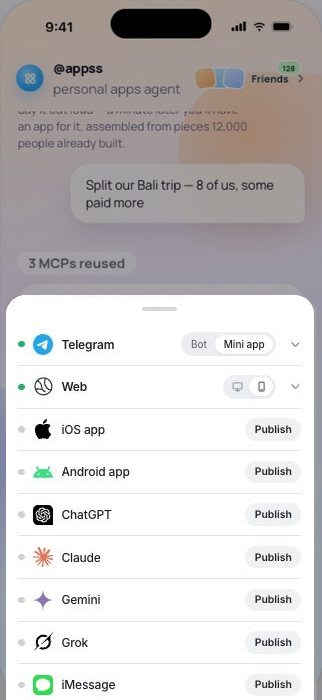

For experienced users and teams
Run your apps at scale with integrations, analytics, push and marketing tools, and publish your own actions that every creator on @appss can build with.
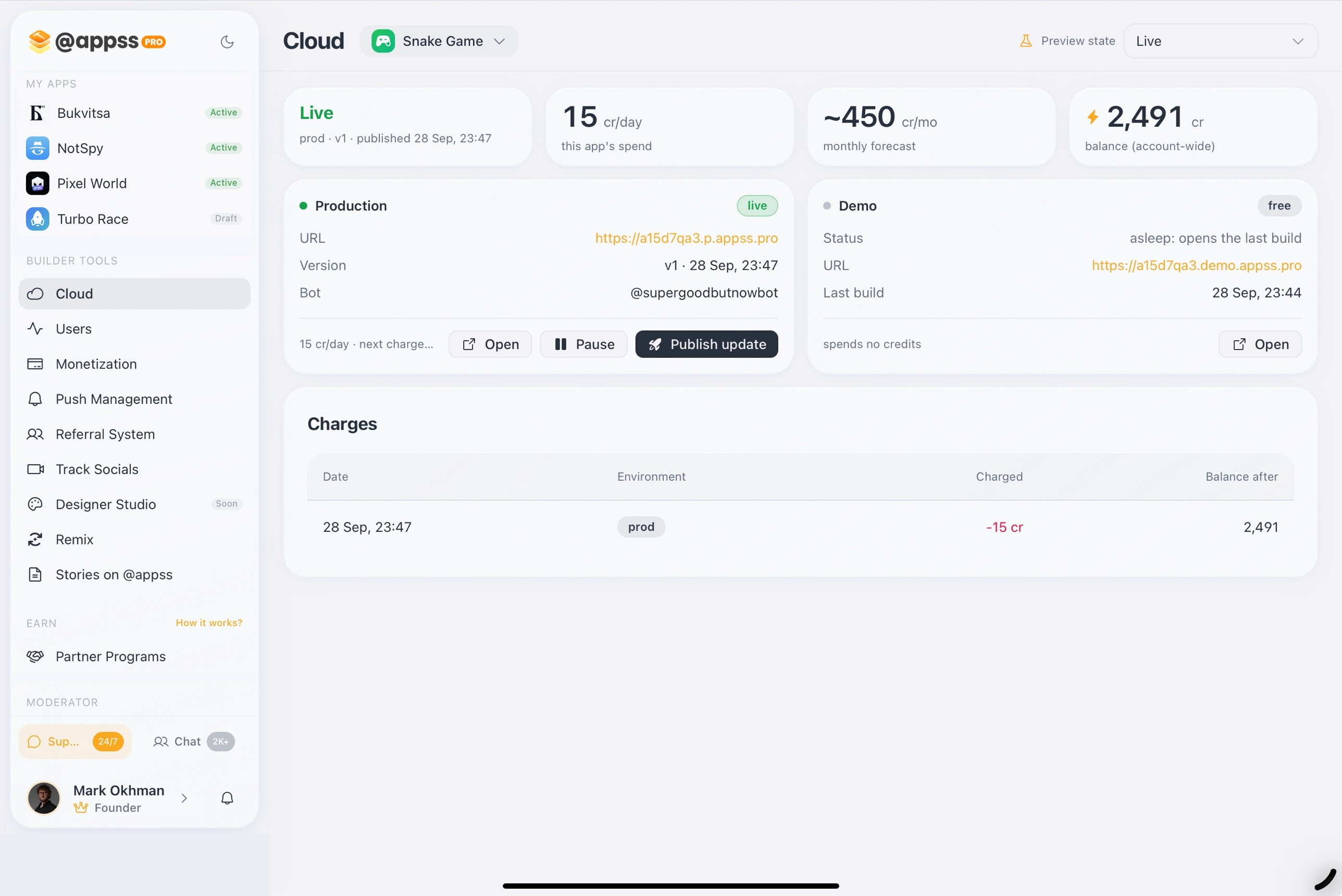
Rebuilt 2026-09-30 (Mark): one horizontal composition instead of three squares. Left column (Mark, 2026-09-30): caption on top with "@appss · connectors", one wrapped row of chips: link icon "500+", Gmail, Calendar, Drive, Maps, Notion, then the MCP chip with ChatGPT / Claude / Grok / Gemini icons; no arrows; then the ChatGPT phone. Center: the mobile app in an iPhone frame, caption on top. Right: @appss Pro caption and a smaller laptop with a real screenshot (Cloud page, Snake Game, 28 Sep 2026, file pro-cloud-2026-09-28.jpg?v=0930f) bleeding off the right and bottom edges.
Center (2026-09-30): two thin-bezel iPhone frames, the native app in front (lower) and the same screen in mobile Chrome behind it (higher) with an iOS-style address bar (our icon + appss.com) and the status bar taken from the app screenshot, the app phone covering most of it; iOS / Android / web icons sit next to the @appss logo in the column caption; hero screen from the Claude Design concept mockup (file app-hero-screen-2026-09-30.jpg?v=0930c), shown in full; caption above it. The ChatGPT screen is an HTML mock of the iOS ChatGPT app (Mark, 2026-09-30: Jira cards in ChatGPT did not render, so the real screenshot was impossible; the card design follows the Claude/Atlassian card): request "Is there any app ideas from my context?", @appss MCP app answers with three app ideas from calendar, mail and chats. Ideas are illustrative examples, not real user data.
@appss Pro is for the ones who want to run it as a business: code access on our own runtime, analytics and push chains, credits and payouts, market research and keywords. Same app, professional tooling. Own runtime, iMessage and MCP are also roadmap items to show on the roadmap slide.
Capable building blocks
Actions
We maintain a unified and verified market of actions ready to be used by apps and agents.
 Extract car specs from PDF
 Turn sheet music into tabs
 Measure rooms from floor plan
 Apps resold as actions
 Tailored actions by pro creators
 Data repositoriesOpen source repos as actionsMCP Registry
 Glama
Glama Smithery
 PulseMCP
 mcp.so
 context.devApify
 RapidAPI
 Firecrawl
 ExaGmailCalendarDriveMapsNotion
 SlackGitHub
 Linear
 Figma
Figma Spotify
 Stripe
 Apple Pay
 Google PayTelegram StarsReddit GoldTikTok BeansRobuxTwitch BitsBase PayWeChat PayShopify Billing
Platforms
Every platform has own stack, runtime, provisioning process and organic traffic rules.
iMessage appsWhatsApp FlowsTikTok MinisYouTube PlayablesReddit Devvit appsTelegram Mini AppsRoblox experiencesDiscord ActivitiesFacebook Instant GamesTwitch ExtensionsShopify appsWorld Mini AppsBase Mini AppsFarcaster Mini AppsWeChat Mini ProgramsAlipay Mini AppsLINE Mini AppsKakaoTalk Mini AppsZalo Mini AppsiOSApp·Widget·App ClipAndroidApp·WidgetMacApp·WidgetWebApp Chrome extension
 Safari extension
 Firefox extensionChatGPTClaude
 Grok
Grok GeminiInstagram DM botsMessenger DM botsX chat agentsSlack appsMicrosoft Teams appsZoom Apps
Added 2026-10-01 (Mark): after the product slide, before the four stages, a slide that lists every source of actions we maintain (MCP servers, connectors, data sources, payments and identity, creators' own actions published on @appss Pro) and every platform we ship to (the same list as the app-stores slide plus web, iOS, Android and Mac). Counts 85K+ and 500+ are the ones already used on the hero and product slides. Generator: scripts/deck_v3_slide_actions.py.
Your real use case becomes an app for millions
You do not bet on one idea. You make many, and each one goes live where your people already are, with no install and no review queue.
 3
3Yourself
Your use case becomes an app you and your agents use daily.
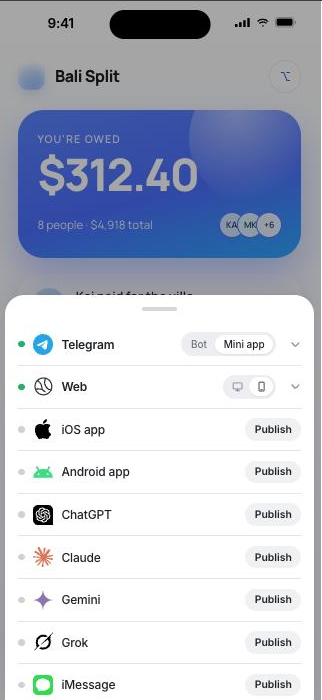
Your people
Your friends get involved and use your app
@appss Mini App

 Web App

 iMessage App

 Reddit Interactive Post

 Messenger Chatbot
 WhatsApp Flow



It spreads
Idea’s usefulness gets multiplied by virality factor
Tally · Expense tracker for Mac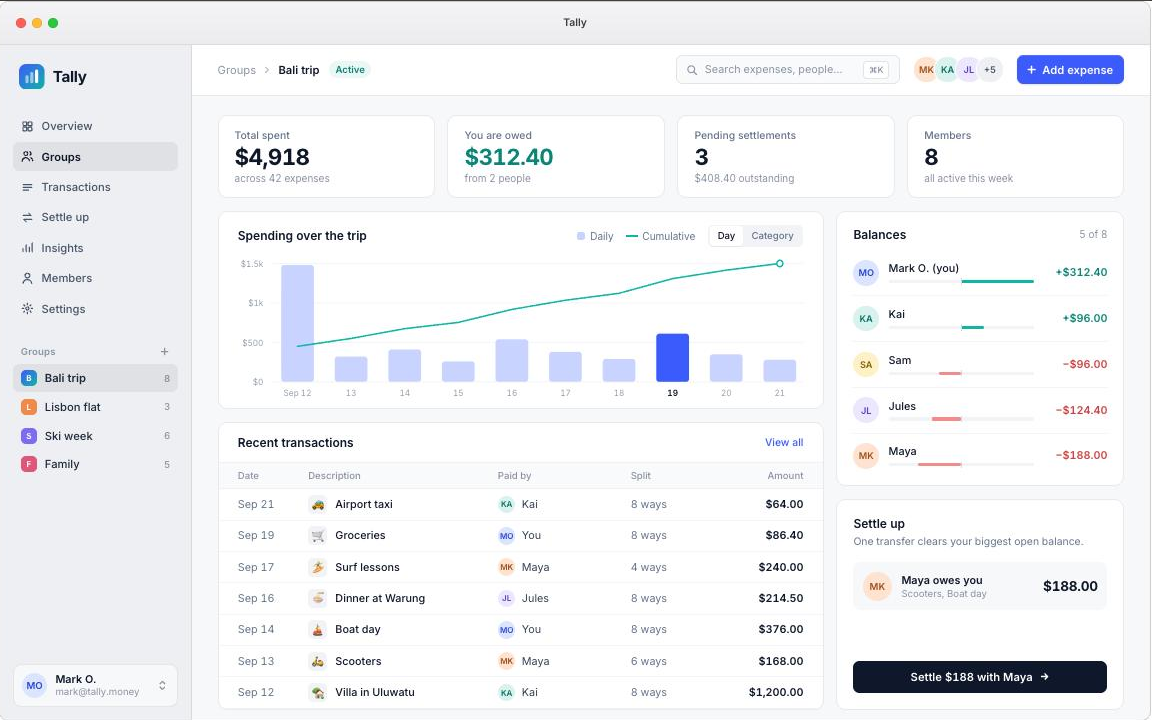
 Tally
Tally$312
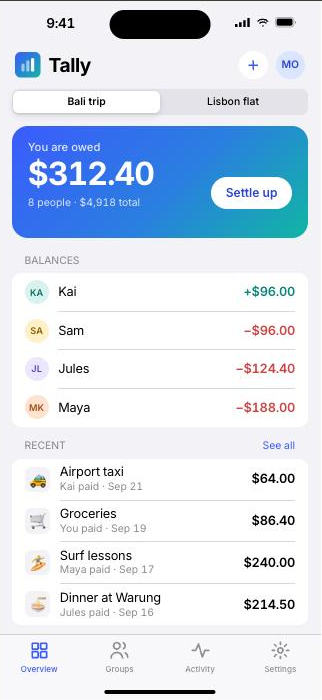
Becomes a business
Simple idea grows into a solid product
2026-09-30 (Mark): Yourself column is a single iOS-style push card drawn in HTML (no phone, no wallpaper, per Mark), with a second card peeking below as the stack; six source circles above with threads ending just above the card. Push text is illustrative.
The combined solution to both problems, told as the life of one app. Stage 1, yourself: the person makes the app for their own use case and uses it daily in the @appss app on their phone. Stage 2, their people: they share it to involve friends or let them use it, for example sending a friend the contact in Telegram or iMessage so the friend enters their part; it opens inside the chat, no install, no sign-up. Stage 3, it spreads: a friend who saw it working recommends it to others; the app was shared only to get some data in, and now it travels chat to chat and group to group. Stage 4, keep them: once there is a crowd, the person builds native apps on top of it for retention and monetization: web, iOS, Android, Mac, widgets, push.
The context block on the left (Mark, 2026-09-30): via MCP we sit in the person's mail, calendar and the assistants they already use (ChatGPT, Claude, Grok), see what they actually do, and suggest which real use cases are worth packaging into an app. So stage 1 usually starts from a suggestion, not a blank page.
Building an app is now the cheap part. A coding agent gets you a working mini-app in days; that is the five percent. What stops creators is everything after: knowing what to build, getting installs, keeping users, taking payments. The build step is a commodity. The rest is the product.
@appss Pro packages that rest as one workflow: 16 tools across Research, Build, Distribute and Monetize, from Market Research and App Remix through to Channel Attribution and Push Management, under one subscription. Creators do not have the budget to glue ten standalone tools together, so we sell the workflow, not the parts.
Every capability is also an AI action surface. Plug Claude or ChatGPT in and drive any tool from chat: track a competitor, send a push to a churned cohort, generate a referral landing. Work front-loads in research and build, then drops, while users and revenue keep compounding on the same stack.
Each capability replaces a stand-alone tool from the web/native world, but built around messenger primitives (Stars, init_data, channel attribution, bot rails) so it actually works for mini-apps.
Why bundled vs. picked à-la-carte
Mini-app creators don't have engineering budgets to glue 10 stand-alone tools. They need one cohesive workflow where build → ship → grow → monetize happens in continuous flow. We sell the workflow, not the parts.
AI Plays on top
Each capability exposes an AI action surface, Claude / ChatGPT plug in and drive any of the 12 capabilities through chat. «Track this competitor app», «Send a push to my churned cohort», «Generate a referral landing», all happen inside the chat thread, executed against the stable stack.
«Build is commodity. We sell the full launch cycle as a single creator workflow.»

Native app stores reward consolidation. A ranked chart pushes each category toward one winner: one booking app takes the downloads and the other 200 fade. UGC platforms reward the opposite. YouTube does not have one cooking channel, it has millions, each personal to its creator. App supply is starting to behave the same way.
The atomic unit is the niche, not the category. A manicurist builds the booking app she actually wants, charges her clients five dollars a month, and is profitable at 100 to 1,000 users. Multiply that across masters, shops, and communities and you get 20,000 apps where a native store allows one.
So we built our store as a long-tail catalog, not a top-50 chart. Telegram alone already carries 8,000-plus of these apps, each with a small, committed audience. We do not need one app to win a category; we need tens of thousands, each good for its own people.
Native app stores reward consolidation. One «manicure booking» app wins; the other 19,999 die.
UGC platforms reward diversity. YouTube doesn't have one cooking video, it has millions, each personal to its creator. Instagram doesn't have one travel-photographer, it has billions, each with their own aesthetic and tribe.
UGC apps follow the same shape. One manicurist makes the booking app she actually wants to use. She charges her clients $5/mo. She forwards her audience to her favorite product-review app for kickbacks. Her audience is small (100-1,000). She's profitable.
What this implies for our store
Apps Store is not a top-50 ranked list. It's a long-tail catalog of micro-niches. 8K+ apps today on Telegram alone. 100K+ by end of 2027. Each one's audience is small but committed.
«One coffee shop. One booking app for that shop. One product page that ranks for that neighborhood. The atomic unit of UGC apps is the niche, not the category.»
Market size
brand deals + platform payouts + direct monetization
builders + social + monetization + infra
We size the market from the buyer out. Creators spend from a $480B economy: Goldman Sachs put creator-economy spend at $250B in 2024, roughly doubling to $480B by 2027. That spend comes from 200-300M creators worldwide, per Linktree and Adobe, about 50M of them professional.
Our serviceable market is the creator tools budget, summed from named analyst segments: AI and no-code app platforms at $45B growing to $102B by 2030 (Grand View Research), social-media management at $36B (Grand View), monetization platforms at $14B and creator infrastructure at $25-38B (The Business Research Company). The sum is $120-133B; segments overlap, so we quote $100B+.
We target $1B+ a year: 1% of that budget top-down, cross-checked bottom-up at roughly 500K paying creators worth ~$2K each, which is 0.2% of the creator base. China already proves the model monetizes: WeChat mini-programs move over $1T a year (Tencent, Q3 2024).
The frame. Creators are the buyer; apps are the next thing they ship and monetize. We size the money around that: the economy they spend from (TAM), the tools budget we bill against (SAM), and the share we can realistically take first (SOM).
Total addressable market - $480B. Goldman Sachs (2023): creator-economy spend $250B, roughly doubling to ~$480B by 2027 - still the most recognizable figure in the room. Independent 2026 reports put the market at $310-323B today growing to ~$820B by 2030 (26% CAGR), i.e. actuals run at or above Goldman’s trajectory. The people: 200-300M creators worldwide - primary studies are Linktree (2022, 200M+) and Adobe Future of Creativity (2022, 303M); no newer primary census exists, 2026 aggregates re-confirm the range. Of those, ~50M are professional/semi-professional (Goldman Sachs) - the 200-300M and 50M are one population at two cut-offs, not two claims.
Serviceable addressable market - $100B+/yr: the creator tools budget, not the developer one. We sell to creators, so the serviceable market is every tool a creator pays for across the launch cycle, from named analysts (2026): AI/no-code app-building platforms $44.6B in 2026 growing to $101.7B by 2030 at 22.5% CAGR (Grand View Research; other 2026 estimates range $29-49B - Mordor, Fortune BI). The vibe-coding sub-segment is the fastest-growing at ~65% YoY, and 63% of AI app-builder users are non-developers (2026 industry data) - i.e. the budget is shifting to exactly our buyer · social-media management $36.4B (Grand View; up to $40B per Research and Markets) · creator-monetization platforms $13.94B in 2026, from $11.57B in 2025, 20.5% CAGR, to $29.07B by 2030 (Research and Markets, Creator Monetization Platform Market Report 2026) · creator tools & infrastructure (AI tools, analytics, creator-management software) $25-38B (8-12% of creator-economy value, Research and Markets). The sum is $120-133B; segments overlap, so we quote conservatively $100B+. The AI-builder wedge is the fastest-growing part, and it is the wedge we enter through.
Serviceable obtainable market - $1B+/yr. Top-down: ~1% of the $100B+ creator tools budget - defensible because a full-cycle platform bills against four segments of that budget simultaneously (build, growth, monetization, analytics), not one. Bottom-up cross-check from the creator side: an average paying creator on the full cycle is worth ~$2K/yr - build subscription plus growth tools (social-media management runs $50-300/mo standalone) plus a take on monetization (the Shopify model: subscriptions + payments yield ~$2-3K/yr per merchant). $1B/yr ÷ $2K = ~500K paying creators - only 0.2% of the 200-300M creator base. Both counts land on the same number from opposite directions. We deliberately do not build SOM on platform GMV estimates - Telegram vendor numbers are unauditable.
Source note. "Research and Markets" is a report reseller; the underlying research house for the monetization and infra segments is The Business Research Company (2026 reports) - we cite the author, not the storefront.
China in the numbers strip. China is the proof of what the app layer looks like at maturity, not a source of Western math: Tencent reports Weixin Mini Programs GMV above ¥2 trillion in a single quarter (Q3 2024) - a $1T+/yr commerce layer inside one app; 1.02B people in China use mini-apps monthly (QuestMobile, Jun 2026); WeChat alone hosts ~4.3M mini-programs - more than App Store and Google Play combined; mini-games, one category, did ¥53.5B (+34% YoY) in 2025.
Why the wave accelerates now
- AI removes the skill gate: our own funnel grew 12 → 140 creators shipping new apps per week within five weeks (our platform DB, Aug 2026).
- Platforms are recruiting supply: TikTok Minis native launch (Jun 2026), Discord Social Commerce (Mar 2026), LINE IAP for all JP devs (Apr 2026), Kakao GameChip (Jun 2026), Apple halved its host commission to 15% (Nov 2025).
- Multi-homing: one creator ships the same app to N surfaces - in China 16 games sat in both WeChat and Douyin top charts simultaneously (Dec 2025).
Categories & competition
@appss Wabi
WabiWe start from the same idea: software for one person's own use, which their friends use too.
Wabi's apps live in its messenger threads, so users must join Wabi.
Ours live in @appss too, but also inside everyday messengers and platforms people are logged into, and can become independent native and web apps, which is what drives monetization.
 MuseGrok Bot
 ChatGPT Dots
These general-purpose agents know the person deeply. Building and publishing an app is heavy for them, and expensive to repeat per idea.
We empower them: through @appss an agent can turn ideas into apps for the person and run them as a business.
 Codex
Codex Claude Code
 Cursor
These agents build anything, but the person must spell out the task, and across every platform we support that brief gets very long.
Checking each platform's result depends on how technical the person is.
 Lovable
 Replit
 v0
v0 Rork
Rork Newly
NewlyExisting builders do the technical part well: a description becomes a website or store app, one platform at a time, and the person takes it from there.
With the person's permission we generate and keep the app alive on far more platforms at once, so ideas get tested and an audience builds up.
 Linktree
 Forms
Forms Calendly
 Typeform
Each tool began as one job done well on its own site, where the result stays: a booking link leads out of the conversation.
They are our map: each job has many use cases people would rather own as an app in their everyday chats, and we build for those markets one by one.
2026-10-01 (Mark): rebuilt as four loose columns in the style of the reworked slides: group title, logo chips with names, one plain text. Order per Mark: personal agents (Muse, Grok Bot, ChatGPT Dots), coding agents (Codex, Claude Code, Cursor), web and mobile builders (Lovable, Replit, v0, Rork, Newly), single-purpose tools; the Wabi row sits under the lead. All texts (lead, Wabi row, four columns) were written on 2026-10-01 through a council: research agents (Wabi facts, X narratives, single-purpose tools, VC critique), then per-text tests by tone, investor and fact agents plus Grok over the xAI API with live X search; see planning/competitors-slide-copy-2026-10-01.md. Facts on the slide: Meta transaction fee (Zuckerberg, Connect, 23 Sep 2026; Meta president, 30 Sep 2026); Wabi 2.0 messenger, invite-only (28 Sep 2026); Google Forms is free, the other three charge. No bold in captions. Generator: scripts/deck_v3_slide_competitors.py.
Wabi took the words "personal software" but only inside their own app: their surface, their runtime, vendor lock. We look at it from the market: the app has to open where the person's people already are.
Lovable, Bolt, v0, Rork are built for someone who already knows they want a web app or a mobile app, and their money went into onboarding that professional user. Our person does not know yet and does not need to; they sell a combination of actions plus an interface. To copy us these builders would have to change their end user, and by then we are the default.
ChatGPT, Claude and Gemini app tools keep the app inside their own chat. None of them will ship to a rival surface, so cross-platform is a lane they leave empty. We stay one step ahead on every new host and run on their tools as actions.
Linktree, Calendly, Typeform, Luma and similar single-purpose tools: a static function on their domain with their data. With @appss the same thing is the person's own software, opens where their people are, and earns among them. Needs a separate workshop for the full list.
The request is real: "создай приложение Делим расходы в поездке", typed into the appss.pro builder on 27 September 2026 (source: builder_idea_submitted events of the @appss Pro app, pulled via MCP on 28 September; 291 requests from 248 people between 17 and 27 September). Other recurring requests in the same ten days: booking for nail and hair salons and detailing studios, habit and expense trackers, "everyone marks whether they come to the court and when", anonymous compliments to friends, daily tarot with friends.
The ideal path for this person: an agent in their own trip chat on WhatsApp or iMessage, made for their own trip first; a fuller Telegram mini app with receipts, currencies and settlement; a Reddit interactive post that runs inside r/travel threads where trip money is already discussed, which is where it spreads; then a native app with widget and push for the ones who come back, with a paid tier for organizers.
The numbers (150 people, 20 paying $19 a month, $380 a month) are the target scenario Mark set for this case, not actuals. Every paid use is split per use across the actions the app calls (FX rates, receipt OCR, payments), @appss keeps 15%, the maker keeps the rest. The next slide shows real cases on Telegram.
People already building
@Temabro123, Kyzylorda 🇰🇿Alisher, Semey 🇰🇿Firdavs, Tashkent 🇺🇿Monarch, Kyiv 🇺🇦 danil.amyashkin, Kyiv 🇺🇦@hrrbl4me, Warsaw 🇵🇱@vlados0008, Denver 🇺🇸
 @timur_kabizhanov, Tbilisi 🇬🇪@Bema_02_11, Bishkek 🇰🇬
Source: builder_message_sent and builder_idea_submitted events of the appssprobot analytics app (text recorded from 2026-09-17). Clustering and verbatim prompts: planning/builder-ideas-2026-10-07/builder_prompts_clusters.md. Chips paraphrase the prompt in English; the city is the creator's time zone city where it is known. Per Mark (2026-10-07) Russia and Iran are not shown; Russian-origin prompts are attributed to Ukraine, Kazakhstan, Uzbekistan or Poland. The map is an illustration, labelled as such on the slide.
Success stories
 Telegram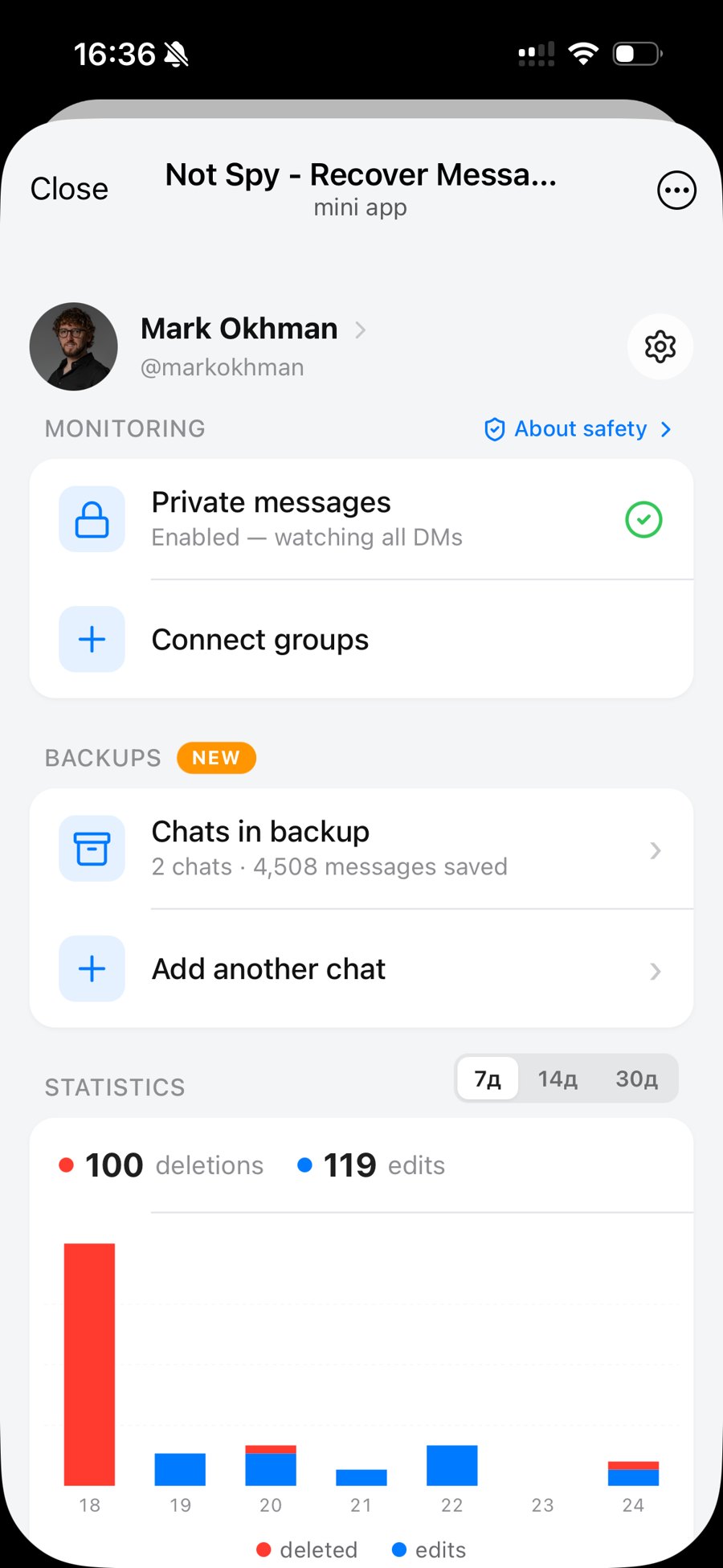
 Telegram
macros per portion
 Telegram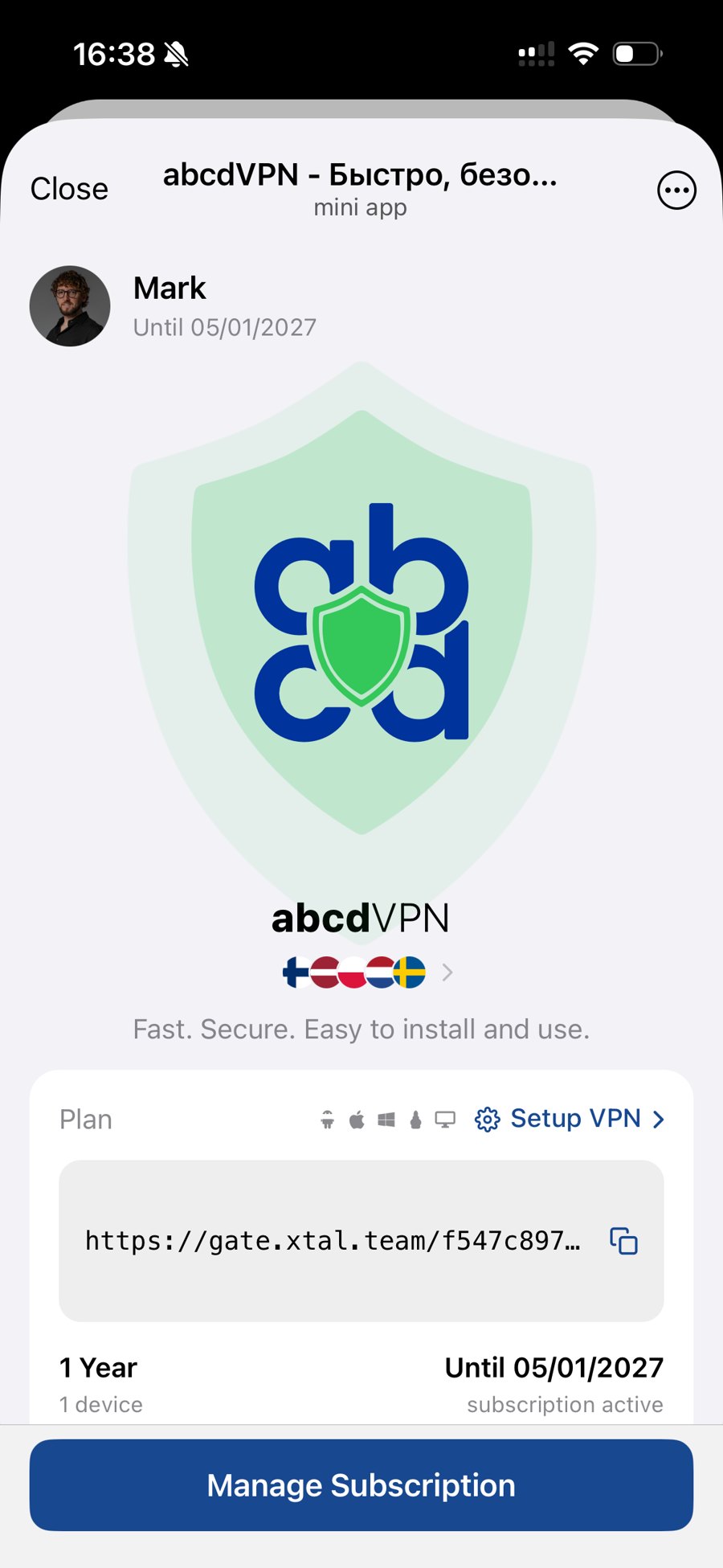
NotSpy recovers deleted and edited Telegram messages. Over the last three months it reached 715K users and $9.5K in MRR, with 2.4M views a month. It is the largest app on the platform, and it grew inside Telegram, where the audience already was.
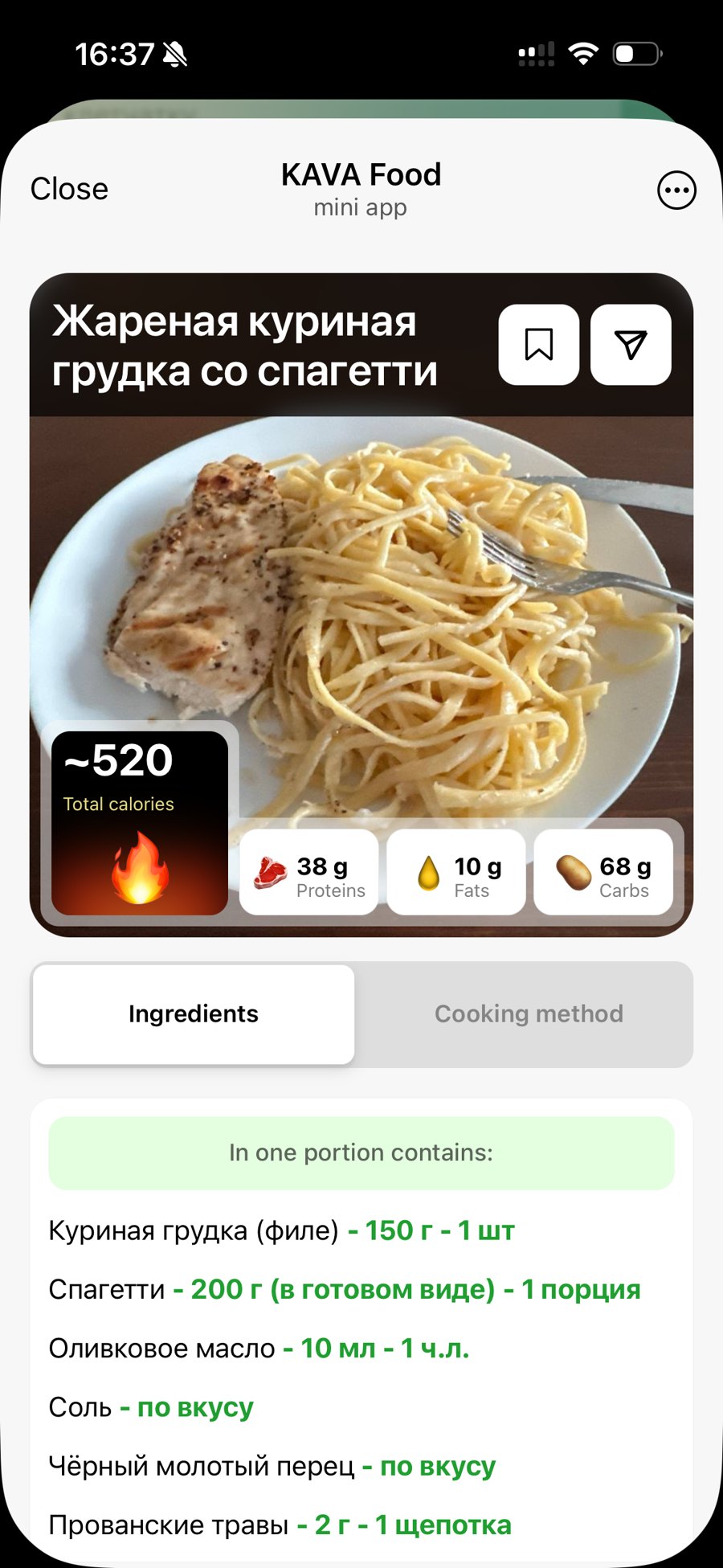
KAVA Food serves recipes with calories and macros per portion. Last month it counted 11.8K users, $540 in MRR, and 940K views. A small, focused utility that a creator could not have justified as a native app; as a mini-app the economics work.
abcdVPN sells one-tap VPN subscriptions inside Telegram. Last month, 300 users produced $1,200 in MRR. Three hundred users is not a big number, and that is the point: with payments native to the surface, an app this small is already a business.
Three creator-built apps on the platform: NotSpy (message recovery), KAVA Food (recipes with macros), abcdVPN (VPN subscriptions in Telegram). Numbers: users, MRR and views over the last three months. [Numbers pending from Mark.]
Traction
Right now we are focused on one thing: turning our existing traffic into paying users. The harness and the core building blocks are built, and we are proving the full loop on one platform first.
We brought the platform online piece by piece. The Analytics SDK shipped in April and has since counted 882K end-users served across creators' apps. Market Research followed in May. In total, the AI tools have handled 11.2K actions across 2,181 creator accounts, and 850 apps built elsewhere came in to list with us.
The AI Builder was the last piece. It launched on July 31 and closed the loop: a creator can now build, publish, measure, and monetize in one place. The response was immediate. In under four weeks, creators built 394 apps from scratch in the Builder.
Monetization switched on last. 123 users now pay, at about $115 average spend. The base is small and recent, and we treat these numbers as groundwork: each metric started at zero when its tool shipped, and August is the first month the complete loop has been running.
Data provenance (production DB + company payment records, as of Aug 25, 2026)
- Apps built / creator accounts: first commit per app in the Pro publishing pipeline (1,263 apps since Mar 5, 2026); 2,867 registered Pro accounts.
- Analytics: events store on the new SDK - 14.2M events, 882K unique end-users since Apr 24, 2026; 7.4M → 14.2M over the last 7 weeks.
- Market Research: AI-credit ledger, feature MARKET_RESEARCH - 4,041 queries, 1,305 distinct creators since May 7, 2026.
- Remix: 889 remixes since Jun 2, 2026 (launch wave Jun, long tail after - shown as a total, not a growth series).
- AI Builder curve: apps with first commit since Jul 31, 2026 (builder launch): 0 → 394 in 3.5 weeks; ledger: 160 creators, 562 builds. Pre-builder platform shipments (889 apps Mar-Jul via templates/bots/onboarding) are deliberately NOT in this curve.
- AI actions (green): full AI-credit ledger - research queries (4,041) + builds (562) + remixes (260) + misc = 11,238 events by 2,578 users since May 7.
- Paying - 123 users, ~$115 avg spend: total across all rails per company payment records (subscriptions, Telegram Stars, bank-settled transfers). The subscription slice (51 payers, RUB/USD/USDT) is dated and verifiable in the production DB; other rails settle outside the analytics DB - series timing per company records.
- Weekly series: distinct creators whose apps had their first commit that week (12 → 56 → 61 → 140 after Builder launch).
- Store listings (dashed): apps published to the store in the window, cumulative +850; the July step is a moderation batch. Total store: 8,933 alive apps.
- Chart normalization: each curve is scaled to its own maximum (no shared Y axis); values are printed on the curves.
What we deliberately keep off this slide
- Revenue: early paid conversions exist but the base is small - we show it with unit economics on a call rather than dressing it up.
- Ecosystem reach (271M combined monthly MAU across 4,786 store apps): a scale credential of the store with overlapping audiences by construction - it belongs to the marketing-engine slide, not traction.
Our marketing engine
We grew our own influencers instead of renting ads. They already monetize our apps - and the same accounts push creators' apps, pumping the market we take a cut of.




across
@m_shulgga15.6M@kinoko03712.8M@bilimbi7210M @banans.life3.9M
 @serebryanka_na1.9M
 @serebryanka_na798.8K
 @notspybot536.5K
 @notspybot1508.8K
 @notnpcguy151.7K
 @banans.life777110.6K
 @nasty_noti90.8K
 @ilya_appss53.4K
 @notspybot_official44.1K
 @cher_poliii33.2K
We do not rent distribution. We run 44 owned influencer accounts across Instagram, TikTok, YouTube and Telegram, with 78K followers and 46.7M views all time. The largest single account has done 15.6M views. Every one of them was grown in house, by our own team, on our own content.
These accounts already work as a channel. They route audience into our own apps and monetize them, so the engine pays for itself while it proves the loop. Track Socials, Influencer Market, Referral System and Channel Attribution inside @appss Pro are the same tooling we use ourselves.
The next step is the market. The same accounts, plus the community around them, will push creators' apps built on our platform. Ad budgets buy reach once. Owned accounts compound, and they pump the market we take a cut of.
Mark Okhman, CEO + founder. Operator-founder, not technical-founder. Multi-year inside the Telegram ecosystem, shipped portfolio apps on top of the substrate (Notspy 115K users live). Owns positioning, fundraising, partnerships, product narrative.
Anton Strekalov, CMO. The marketing engine. Generated the inbound that drove early @appssPro signups (tens of millions of views across IG / TG / YT). Owns the creator-acquisition pipeline + Anton's network of Telegram operators.
Maksim Zhers, CTO. Senior engineer with deep Telegram Mini Apps experience. Owns architecture: builder, hosting, push, store, scoring. The backend that survives 1M+ push deliveries and 49K reviews.
Why this team
You need (a) an operator-founder who eats own stack, (b) a marketer who can recruit creators by their language, (c) an engineer who's already shipped at this substrate's depth. Together = an extremely tight execution machine for the Telegram + messenger-ecosystem play. Each role is irreplaceable.
«Founder + driver + builder. Backed by an investor (Loom) who's been on this thesis since Day 1.»
The base is the subscription. Each plan includes a monthly credit budget of around 3,000 credits, and every tool draws it down: research queries, builds, remixes, pushes. AI tools are priced at cost times two, infra and ops tools at three to five, so revenue tracks real usage and margin grows with scale.
The second stream is aggregated traffic. Apps built on the platform funnel their audience through the @appss store, and that Store MAU becomes inventory we sell per impression and per outcome, to Pro creators and external advertisers. More apps means more traffic to sell; the first stream feeds the second.
The third is partner flows. When creators and influencers make deals through the platform, we take a cut of each one: a fee per Influencer Market order, a percentage of referral-program budgets. Each stream raises the others, so a marketing dollar spent acquiring one subscriber ends up working across all three.
Credit model. Credits are the internal meter. The subscription includes a monthly Credit budget; every tool - build, assets, API/LLM calls, market research, push - consumes Credits, so revenue tracks real usage. Overage is pure-margin top-ups. Per-app × per-team: 5 portfolio apps = 5 subscriptions.
Aggregator economics. Notspy did 115K users on stack 1.0; next-gen apps could do 1M+ each. Their audience passes through the @appss store to discover apps and becomes Store MAU, which we resell as targeted impressions + outcomes to Pro creators and external advertisers. One unicorn funds the rest.
Partner take-rate. Influencer Market fee per booking, partner-program split per conversion, bounty cut on payout - each compounds with app count and Store MAU.
Structural alignment vs «vendor lock»
We don't own equity in creators' apps. We don't try to. We own the audience-aggregation layer underneath them. Creators get the best tools, best store distribution, best monetization. We get the economics under all of it. Both win.
«SaaS floor, aggregator ceiling, no cap - one app's success funds a hundred others.»
Roadmap
As our stack covers all the ecosystems supporting mini apps, our North Star metrics are the amount of mini apps launched through the stack and the MAU of mini apps launched.
Twelve of the sixteen tools are live today. APIs & LLMs and the Influencer Market ship in September; Designer Studio and Support close the set in October. From that point the product surface is complete, and the work shifts entirely to distribution. That is the whole game for the next two quarters.
Distribution runs platform by platform. Reddit and WhatsApp in September; YouTube, TikTok and Discord in October; Instagram, Messenger, Facebook and iMessage in November. WeChat, LINE and Zalo follow in December, with Alipay, Douyin and Weibo through the first quarter. The West first, then China, in the order access opens.
The numbers are outputs of a loop, not a forecast. Each platform adds creators, each app becomes a template others remix, and remixes carry into the next platform. Run at this cadence, that loop is built to produce one million mini-apps by year-end and three million by March. Targets, not promises.
Planned content: remaining tools (Designer Studio, Support, Stories, Bounty...), dates, and the compounding argument from the Traction slide continued.
Team
 Telegram team (TON Foundation). Shipped multi-app portfolio on the substrate. Operator-founder; eats own stack daily.
 as @loomdart, 300K+ followers.
  Ethereum maxi, serial entrepreneur and angel investor.
 Instagram, TikTok, and YouTube. Owns growth + creator pipeline. The marketing engine.
We are operators, not observers. Before building the platform we shipped our own apps on the Telegram substrate; Notspy alone runs at 115K users. The stack we sell is the stack we use daily, so every tool exists because one of our own apps needed it first.
The team fits the problem three ways. Mark, ex-Telegram team and TON Foundation, runs product and positioning as an operator-founder. Anton has generated billions of organic views on Instagram, TikTok and YouTube and recruits creators in their own language. Max built at Telegram Mini Apps depth and owns the platform.
This market is won from inside the ecosystems, and our 15+ teammates already work there: UGC operators, growth engineers and mini-app developers embedded in Instagram, Telegram, TikTok and Meta. @loomdart, co-founder and early backer, has been on this thesis since day one.
Mark Okhman, CEO + founder. Operator-founder, not technical-founder. Multi-year inside the Telegram ecosystem, shipped portfolio apps on top of the substrate (Notspy 115K users live). Owns positioning, fundraising, partnerships, product narrative.
Anton Strekalov, CMO. The marketing engine. Generated the inbound that drove early @appssPro signups (tens of millions of views across IG / TG / YT). Owns the creator-acquisition pipeline + Anton's network of Telegram operators.
Maksim Zhers, CTO. Senior engineer with deep Telegram Mini Apps experience. Owns architecture: builder, hosting, push, store, scoring. The backend that survives 1M+ push deliveries and 49K reviews.
Why this team
You need (a) an operator-founder who eats own stack, (b) a marketer who can recruit creators by their language, (c) an engineer who's already shipped at this substrate's depth. Together = an extremely tight execution machine for the Telegram + messenger-ecosystem play. Each role is irreplaceable.
«Founder + driver + builder. Backed by an investor (Loom) who's been on this thesis since Day 1.»